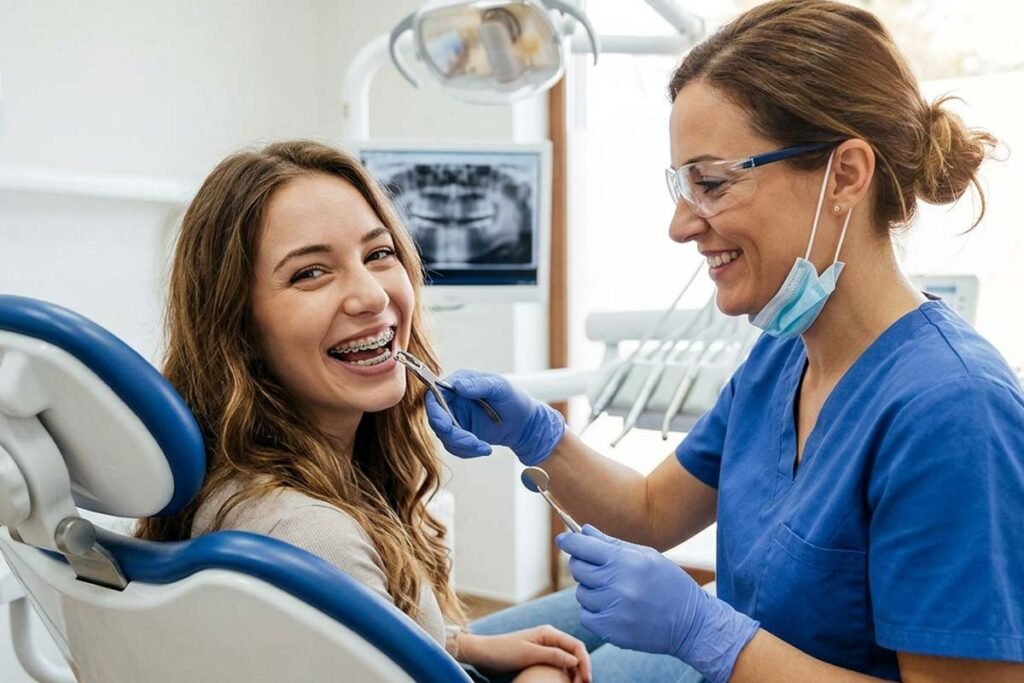
Immediately after getting braces, general expectations are moderate soreness, excessive pressure on teeth, and irritation against the cheek for a few days. At the Art of Smile, you will get frequent support after the treatment. Here is the breakdown of the post-operative instructions in different phases that you should follow.
Phase 1: The First 24 Hours are Important
Immediately after getting braces, you might feel a bit of tightness, but at this point, you won’t feel any pain.
After 4 to 6 hours, the tooth movement will start, and your periodontal ligaments will start to stretch and compress.
- What will you feel?
You will feel a heavy pain if your teeth are bruised and you will experience biting as surprisingly sensitive. - Take an Action
Ensure to take painkillers before the pain becomes intense. Instead of taking medicine, you can also try some home remedies, such as sipping on ice-cold water, or you can eat a fruit smoothie. - Pay Attention
When you go to bed, check out your braces using your fingers and tongue. If you feel a wire poking back to your cheek, brackets rubbing against your lips, or any other discomfort.
Use the provided orthodontic wax immediately to reduce the effects because they will become more painful till the morning.
Phase 2: The Next Seven Days
This is the peak of the adjustment period, and at this stage, you need to be extremely cautious because your mouth’s soft tissues are learning to navigate around the brackets.
- What will you feel?
After 3-4 days, you can feel a loose tooth sensation, and your front teeth will feel slightly wobbly. It is a normal feeling because the surrounding bone may feel slightly soft. - Take An Action
With slight pressure, you may develop sores and ulcers. Salt water rinse is a Golden rule for orthodontic recovery. Take ½ teaspoon of salt, a cup of water, swish for 30 seconds and spit, do it on repeat mode at least 4-5 times. Alternatively, you can also use wax.
Phase 3: The New Diet You Must Adapt
Your diet plays a vital role in your recovery. For the first week, you should stick to negligible tearing and chewing.
- Proteins: Intake can be enriched by sources such as eggs, soft-cooked fish, tofu, and sliced deli meats.
- Grains: mashed potatoes, soft pasta, and oatmeal, etc.
- Dairy Products: yoghurt, puddings, and cottage cheese.
The List You Should Forbid Until Your Braces Come Off!
- Hard Foods: The food list you should forget about includes Pizza crusts, nuts, ice cubes, hard pretzels, and corn chips etc.
- Sticky Foods: The list includes caramel, taffy, candy, and chewing gum etc.
- Mindful Bites: Never take a direct bite on an apple, a pear, or corn; make sure to cut them into small pieces before eating.
Phase 4: Oral Hygiene Excellence
Braces are food magnets. Every time you eat food, the chances of leaving debris around the brackets increase, and there is a possibility for plaque build-up. If the brackets are left untreated, there would be a formation of white patches that would be clearly visible even after the braces are removed.
- The Brushing Protocol
Brushing is extremely important. If you are at school, you can rinse your braces with water. While brushing, you must hold your brush at an angle of 45 degrees. Make sure to clean your teeth gently. - Flossing Challenges
Flossing with braces is extremely difficult, but one can’t avoid it. The process ensures deep cleaning so that no debris can get collected under the wire. You can also make use of water flossers. They help to get rid of the debris even from places where the string can’t be reached.
Phase 5: Troubleshooting
Not every inconvenience requires an immediate trip to the dentist, but you should know what emergencies require immediate troubleshooting. Here we are providing the list, you should go ahead.
- Poking Wires: sometimes braces get shifted towards the back of your mouth and start rubbing against the cheek, you should place them back to their place using an eraser and the end of the pencil. If shifting doesn’t take place, you can apply some wax and make your visit to the office. If nothing helps you may take a cuticle cutter and clip the end of the poking wire.
- Loose Brackets: This is a common issue; to recover from the problem, you must cover it with wax if it is irritating you. If the bracket comes loose from the wire, save it and bring it to your next appointment. Do not throw it away.
- Lost Ligature: In case one rubber band pops off, it is actually not an emergency, but in case there is a loss of multiple bands, you should make an emergency visit to the dentist’s office.
The Ultimate Success
Orthodontic treatment is a series of constant visits for braces, a minimum of 6 – 8 weeks is required, with a number of sittings. If you want to finish your treatment on time, make sure to maintain consistency. To know more you should take professional advice from an experienced orthodontist like Kanchi Shah.
The other most important thing is to keep your braces protected against accidents while playing outdoor sports. To avoid the situation, make sure to wear loose non-molded mouthguards.
Final Thoughts
Braces work wonderfully to redefine your smile once again. The initial process might be painful and can be difficult to manage, but in the end, you will get your desired smile back. You can make your braces journey easy by brushing, flossing, and following food restrictions. Wax application is something that manages all the minor issues.
FAQ’s
How long does the pain last after wearing braces?
Usually, the pain will be at its peak within the first 48 hours, but with the passage of time, the pain will diminish, and gradually it will not feel so intense.
What food should I eat while wearing braces?
After braces placement, make sure to change your eating habits. Include soft food in your diet and avoid hard and crunchy food till you are wearing braces.
Can I participate in sports while wearing braces?
Yes! You can wear braces while playing but make sure to wear a loose mouthguard.
What if my braces come off?
There are minimal chances for this thing to happen, but in case it happens, make an immediate visit to your dentist.
What are the common types of braces?
Metal Braces: This is the most common type, made of high-grade stainless steel.
Ceramic Braces: They are tooth colored clear brackets that are less visible than metals and provide you with a natural smile.
Lingual Braces: These go on the inside of the mouth, slightly more discomfort is expected with this one due to the tongue being so close to it.