You finally finished your orthodontic treatment. The brackets are off, the clear aligners are packed away, and your teeth are perfectly straight. It is a massive milestone that deserves celebration. Naturally, the next major step you are thinking about is making that straight smile bright and white.
Here at Art of Smile Philadelphia, we want to help you maximize your cosmetic results safely. Since you already wear custom clear retainers every single night to protect your alignment, you might be wondering if they can pull double duty.
Can you seamlessly handle at home teeth whitening after braces using the gear you already own?
Or do you need an entirely separate cosmetic treatment tray? The good news is that whitening teeth with retainers is completely possible, but your technique must be precise.
Let’s look at exactly how to whiten teeth while in retention safely without harming your gums, ruining your tooth enamel, or warping your appliance.
Retainers vs. Whitening Trays: The Structural Difference
Before squeezing bleaching gel into your clear plastic alignment piece, you need to understand how it differs structurally from a traditional cosmetic tray. Knowing these variations is crucial when planning on whitening teeth with retainers safely without irritating your oral tissues.
| Feature | Clear Orthodontic Retainers | Custom Whitening Trays |
| Primary Purpose | Stabilize tooth positions; prevent relapse | Hold bleaching gel uniformly against enamel |
| Material Fit | Ultra-tight, rigid, vacuum-formed plastic | Slightly flexible; customized but less restrictive |
| Gel Reservoirs | None. Fits flush against the tooth surface | Built-in pockets on the front of each tooth |
| Gum Line Edge | Straight-cut; often covers part of the gum | Scalloped edge to entirely avoid soft tissues |
| Overflow Risk | High; tight fit forces excess gel upward | Low; reservoir keeps the active gel contained |
Because clear retainers lack built-in gel pockets, pushing a thick layer of bleaching fluid inside forces the excess directly onto your soft tissues. Mastering this mechanical difference is key to a successful at home teeth whitening after braces regimen.
Why Opalescence 10% is the Gold Standard for Retainers
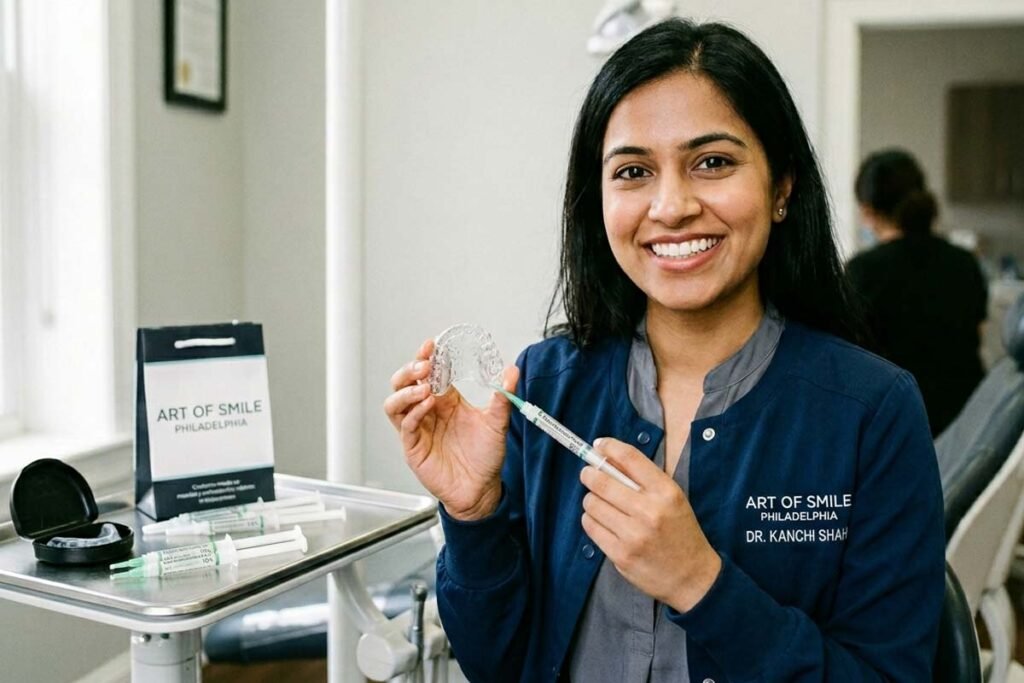
When you are choosing a whitening gel for a tight-fitting retainer, concentration matters significantly. Higher percentages of whitening agents work faster, but they require built-in tray reservoirs to stay safe. If you place a high-strength gel inside a tight orthodontic retainer, it will immediately spill onto your gums, causing painful chemical burns.
This is why an opalescence 10 in retainer setup is widely recommended by professionals such as Kanchi Shah.
The 10% carbamide peroxide concentration contains roughly 3.6% hydrogen peroxide. This milder formula is specifically designed for a slow, controlled release of whitening power. It breaks down gradually over several hours, making it highly effective yet incredibly gentle on your enamel.
Furthermore, Opalescence formulas contain potassium nitrate and fluoride. These specialized ingredients work actively to desensitize your nerve endings and strengthen your enamel throughout the whitening cycle.
The 10% gel syringes we give them with their retainers -Opalescence Go™ 15% Prefilled Whitening Trays, the prefilled trays can be used by anyone even without retainers.
Step-by-Step Instructions for Using Opalescence 10%
To get professional results without damaging your oral health, you must follow a precise application technique.
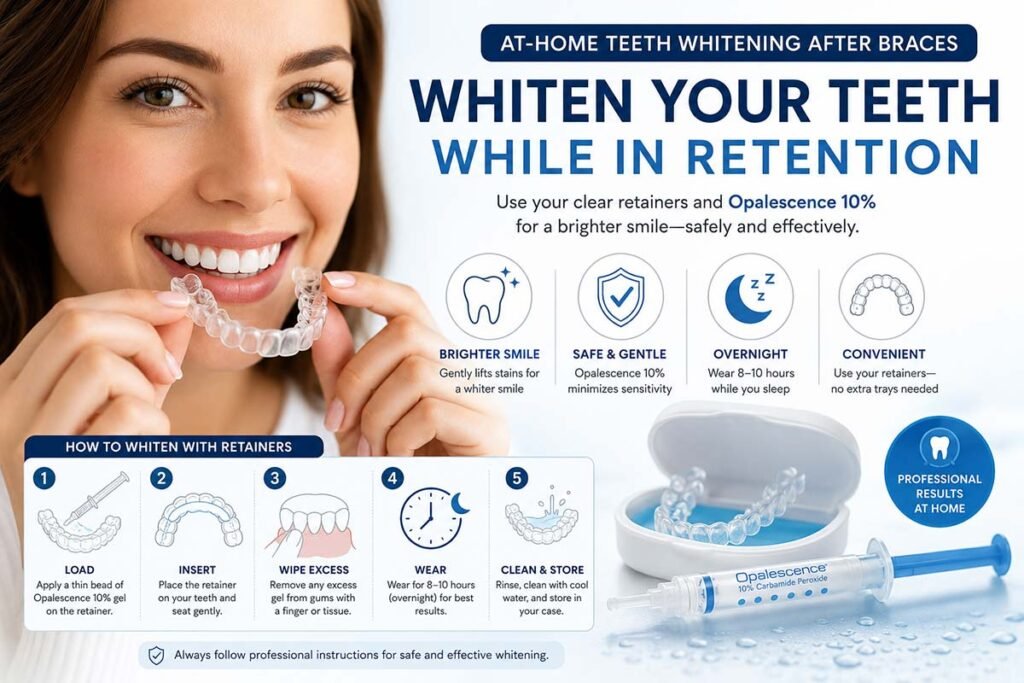
1.Load the Retainer:Use 1/3 to 1/2 syringe per arch.
Express one continuous bead of gel along the lower half of the cheek side of the retainer. Do not overfill the plastic tray.
2.Insert and Adapt:Seat the retainer gently.
Place the loaded retainer over your teeth. Lightly tap the sides of the plastic to adapt the gel directly across your tooth surfaces.
3.Remove Excess Gel:Immediate gum protection.
Check the mirror immediately. Use a clean finger, a dry tissue, or a soft toothbrush to wipe away any excess gel that squeezes onto your gums. Do not swallow any rinsed gel.
4.Maintain Wear Time:8 to 10 hours or overnight.
Because the 10% formula releases its active ingredients slowly, it is designed for extended wear. You can safely wear it for 8 to 10 hours, making it perfect for overnight use while you sleep.
5.Clean and Store:Post-treatment care.
Remove the retainer in the morning. Clean the tray thoroughly with a soft toothbrush and cool water to remove all leftover residue. Store it safely in your protective case.
Managing Wear Time and Sensitivity
When you are whitening teeth with retainers, timing is everything. While 10% carbamide peroxide is safe for extended wear, your tight retainer can accelerate tooth sensitivity.
- Start small: Wear the gel-filled retainer for just 1 to 2 hours on your first day to test your tolerance.
- Gradual progression: If your teeth feel fine, you can gradually transition to wearing it during your normal overnight sleep schedule.
- Take breaks: If you experience a sharp zing of sensitivity, skip a night. Whitening is a marathon, not a sprint.
To keep the process completely comfortable, brush with a dedicated potassium nitrate sensitivity relief toothpaste for two weeks before and during your whitening cycles.
Long-Term Maintenance: Keeping Your Smile Bright
Once you complete your initial whitening cycle, your primary focus should shift to long-term maintenance. Smiles naturally fade over time due to aging and dietary habits. Fortunately, whitening teeth with retainers makes touch-ups incredibly simple. You do not need to restart a full two-week regimen every time your smile loses a bit of luster.
Instead, keep a syringe of opalescence 10 in retainer storage ready for occasional single-night treatments. Applying the gel for just one night every three to six months is typically enough to lift surface stains and maintain your ideal shade.
This preventative approach keeps your smile dazzling without over-exposing your teeth to bleaching agents. Maintain your regular 6 month cleaning appointments for any harder stains as they can prevent direct contact of your gel to the enamel and reduce efficacy.
Conclusion
Whitening teeth with retainers is a cost-effective way to maximize your orthodontic investment. By using a gentle 10% gel, applying micro-dots, and protecting your gums, you can safely brighten your teeth at home.
Remember, clear retainers are medical devices designed to keep your teeth straight. Protect them by avoiding hot water and harsh chemicals. When done correctly, at home teeth whitening after braces is the ultimate way to showcase your straight, beautiful smile.
FAQs
Will whitening my teeth in a retainer cause white spots?
No, as long as all braces and residual dental glue are fully removed.
Can I use standard whitening strips inside my clear retainer?
No. Putting thick physical strips inside an orthodontic retainer will alter its precise internal fit. This prevents it from holding your teeth in place and can permanently crack or warp the expensive plastic.
How often should I whiten my teeth while in retention?
Use the gel for 10 to 14 consecutive nights for an initial full whitening cycle. Once you reach your desired shade, switch to a touch-up night every 3 to 6 months to maintain brightness.
Will the whitening gel damage or discolor the retainer plastic?
Professional, dentist-approved gels like Opalescence are entirely safe and will not cloud medical-grade plastics. You must clean your trays properly between uses. Avoid cheap, highly acidic over-the-counter formulas, which can cause micro-abrasions or chemical erosion of your appliance.
Why do my teeth feel sore if 10% gel is considered safe?
The tight, un-scalloped fit of a retainer intensifies the peroxide breakdown against your enamel. If you experience aching, simply reduce your wear time from overnight down to 1–2 hours, or skip a night.